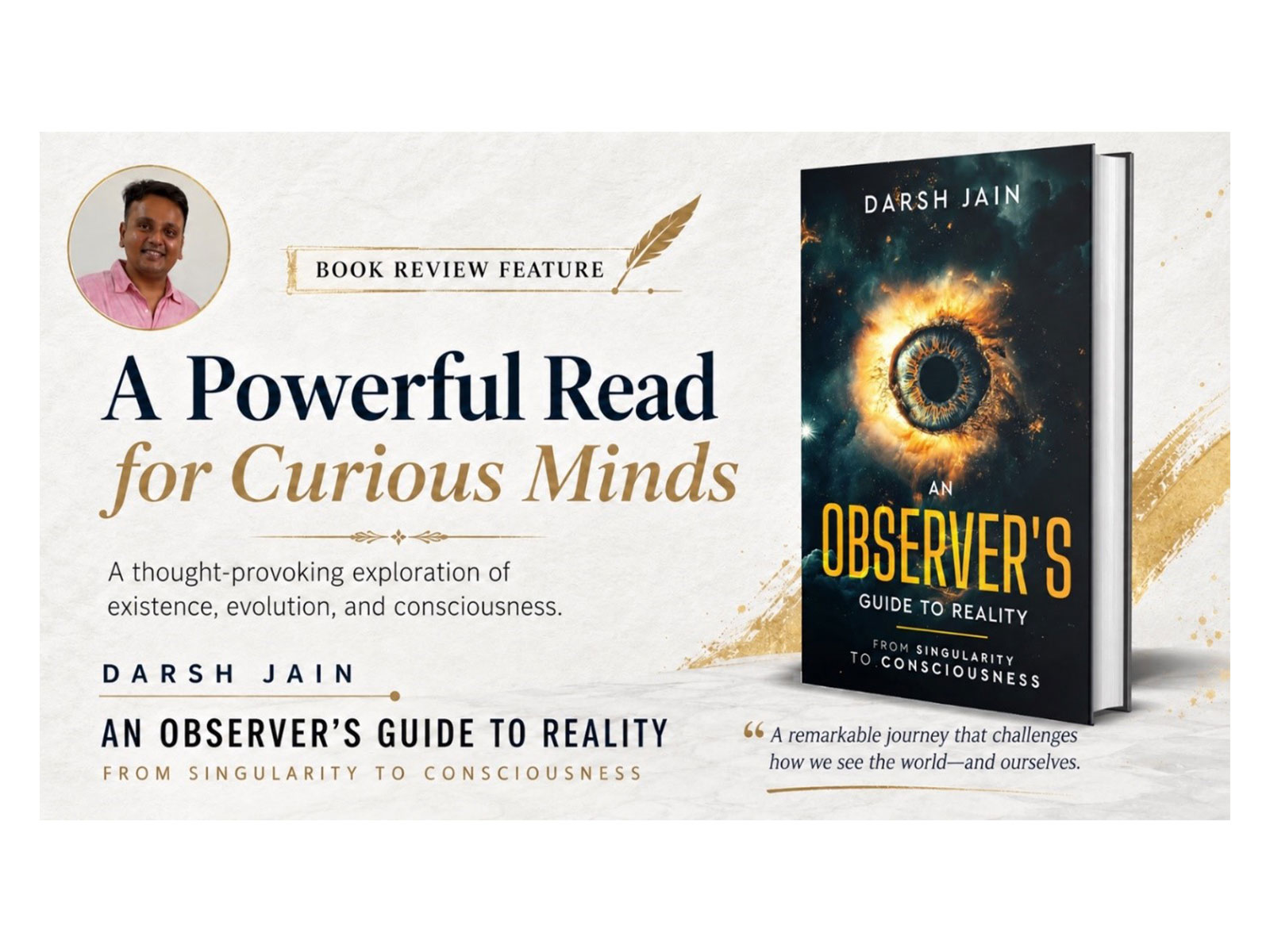
An Observer's Guide to Reality by Darsh Jain is a Bold Intellectual Journey from the Birth of the Universe to the Mystery of the Human Mind
Aug 17, 2026
VMPL
New Delhi [India], August 17: In an age overflowing with information, opinions, beliefs, and endless digital noise, books that encourage people to genuinely stop, question, and understand have become increasingly valuable. An Observer's Guide to Reality: From Singularity to Consciousness by Darsh Jain is one such work, a book that does not simply present information, but invites readers to reconsider the foundations of existence, human behaviour, belief, identity, and consciousness.
What makes this book especially powerful is the scale of its journey. It begins with some of humanity's oldest questions: Where did the universe come from? How did matter form? How did life emerge? And how did a collection of atoms eventually become a conscious being capable of asking, "Who am I?"
The book moves from the Big Bang and quantum reality toward evolution, Homo sapiens, human societies, meaning, and finally the observer within us.
That progression gives the book unusual energy. It does not remain trapped within a single discipline. Physics leads into chemistry, chemistry into biology, biology into evolution, evolution into anthropology, and anthropology finally into questions about the mind. The author openly states that the goal is not to overwhelm readers with terminology, but to explain complex ideas in accessible language and encourage scientific thinking and rational inquiry.
This accessibility is one of the book's strongest qualities. Subjects such as quantum mechanics, molecular biology, human evolution, neurobiology, free will, language, and consciousness can easily become intimidating. Darsh Jain instead approaches them conversationally. The reader is not treated like a student preparing for an examination, but like another curious human being sitting across the table and asking the same difficult questions.
"Darsh Jain has taken on an ambitious task: connecting the vast story of the universe with the deeply personal question of who we are. What makes the book compelling is its ability to turn complex ideas into an accessible, thought-provoking journey. As the marketing partner, we see An Observer's Guide to Reality as a book that can resonate strongly with curious readers who are looking beyond information and searching for a deeper understanding of existence, consciousness, and themselves," says MissBookThief, the book's marketing partner.
That ability to bridge complexity and curiosity is central to the book's appeal. Rather than presenting science, philosophy, and human history as isolated subjects, An Observer's Guide to Reality attempts to connect them into one continuous story. The result is an exploration that constantly moves between the enormous and the intimate, from the origins of the cosmos to the thoughts unfolding inside an individual human mind. The importance of An Observer's Guide to Reality becomes even clearer when the narrative reaches Homo sapiens. The book explores not only how human beings evolved physically, but how cooperation, language, culture, imagination, and shared belief allowed our species to build civilizations.
It examines how the systems surrounding us, including money, nations, laws, symbols, identities, and other collective structures, gain extraordinary power because groups of people agree to believe in them. This idea of "imagined orders" gives the book particular relevance to modern life. We often move through society assuming that the structures around us are permanent and unquestionable. The book encourages readers to examine how much of what feels completely real is actually created, maintained, and reinforced through language, memory, culture, and collective agreement.
Yet the book does not stop at society. Its most personal questions arrive when it turns toward consciousness and the self.
Darsh Jain examines how the feeling of "I" may emerge from memory, emotion, neural activity, language, and the brain's continuous act of constructing a personal narrative. The book asks whether the self is fixed at all, or whether it is an ongoing story created by the brain. This is where the book becomes more than a scientific overview, it becomes a mirror.
The final idea, "Observe the Observer," asks readers to notice their own anger, fear, joy, beliefs, reactions, and inherited assumptions. Instead of immediately identifying with every thought or emotion, the book encourages the reader to examine how those experiences arise.
Another reason the book stands out is the personal journey behind it.
Darsh Jain describes how preparing for the civil services examination led him through an enormous range of subjects, but also toward an important realization: collecting knowledge and genuinely understanding life are not the same thing.
His experience pushed him to question the purpose of knowledge itself and eventually explore history, anthropology, evolution, biology, quantum mechanics, and philosophy in a connected way. That personal foundation gives the book sincerity. It does not present itself as the final answer to reality. In fact, one of its central strengths is its willingness to acknowledge uncertainty.
The author repeatedly emphasizes questioning, evidence, curiosity, and the humility to accept that we do not know everything. For readers, that may be the book's greatest contribution. An Observer's Guide to Reality is important because it invites us to move beyond memorized answers. It asks us to look at existence from the largest possible scale, the universe, and then gradually turn that gaze inward toward ourselves.
It is energetic because every chapter pushes into another fundamental question.
It is intellectually provocative because it challenges inherited assumptions without asking readers to replace them with another rigid belief.
And it is relevant because, in a world where certainty is often louder than understanding, Darsh Jain offers something more valuable: an invitation to observe, question, reflect, and think again.
Ultimately, this is not simply a book about the universe. It is a book about the extraordinary moment when the universe became capable of observing itself, and about what we choose to do with that awareness.
About Author
Darsh Jain is a writer, independent researcher and thinker fascinated by the questions that lie at the intersection of science, philosophy, psychology and human evolution.
Driven by years of independent research across cosmology, evolutionary biology, neuroscience, anthropology and philosophy, he seeks to bridge scientific understanding and philosophical inquiry -- challenging conventional narratives and inviting readers to observe, question and rethink their assumptions about reality, identity, morality, free will and the human experience.
His mission is to make complex ideas accessible while encouraging independent thought. He is the founder of An Observer's Dialogue, a platform exploring science, philosophy and critical thinking.
Buy your copy: https://www.amazon.in/Observers-Guide-Reality-Singularity-Consciousness/dp/934747276X/ref=sr_1_1?crid=16MPRIRCG9OVP&dib=eyJ2IjoiMSJ9._y2rMymscbj-ottM6V12q6tIoaHYR1cTygyRd-q4ps1PCRE7j8E7QG-D1y4oZ3PKQwhhJUFXhlB-m1SfXlzI6Z6dPoXYvC_ehUyj3SEU_63ixc4iXIvCABIAZCT02-j7.KqHkrm2u1o3io1jOsi4WvyuxgJral_wE2sTEGI0hkGE&dib_tag=se&keywords=darsh+jain&qid=1786539133&sprefix=darsh+jai%2Caps%2C234&sr=8-1
(ADVERTORIAL DISCLAIMER: The above press release has been provided by VMPL. ANI will not be responsible in any way for the content of the same.)