
From Gen Z to Older Investors, Mutual Fund SIPs Find Their Place Across Age Groups
Nov 11, 2026
VMPL
New Delhi [India], November 11: At an Indian family gathering, conversations about money can sound quite different depending on who is speaking. Someone may be renewing a fixed deposit, another discussing a monthly systematic investment plan (SIP), while a parent sets aside money for a child's education. The underlying priority remains familiar: saving today to meet future financial needs. What is gradually changing is how households choose to allocate those savings.
For decades, bank deposits, gold and property have remained familiar investment and savings options for Indian households. While these continue to serve important purposes, mutual funds are becoming a more prominent part of financial planning. The AMFI–Crisil Factbook 2026 provides insights into this evolving pattern, highlighting the growth of mutual fund assets and the increasing role of systematic investments across different age groups.
Mutual Fund Assets Have Grown Faster Than Bank Deposits
India's mutual fund industry recorded substantial growth over the five years ending March 2026. According to the AMFI–Crisil Factbook 2026, industry assets under management (AUM) increased from ₹31.43 lakh crore in March 2021 to ₹73.73 lakh crore in March 2026, representing a compound annual growth rate (CAGR) of approximately 18.6 percent.
Bank time deposits also expanded during this period, increasing from approximately ₹133 lakh crore to ₹225 lakh crore. Based on these rounded figures, the corresponding CAGR was approximately 11.1 percent.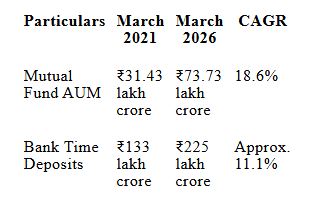
Source: AMFI–Crisil Factbook 2026. Deposit figures are rounded, and the deposit CAGR is calculated using the displayed values.
The changing allocation of household financial savings offers another perspective. According to figures cited in the industry research, mutual funds' share of the gross annual flow of household financial savings increased from approximately 3 percent in 2020 to 13 percent in 2025. Over the same period, the share attributed to total deposits moved from 37 percent to 35 percent.
These figures do not suggest that households are abandoning deposits. Instead, they indicate that mutual funds are accounting for a larger proportion of annual financial savings flows, even as traditional deposits continue to play an important role.
From Gen Z to Older Investors: SIPs Across Different Life Stages
Systematic investment plans allow investors to contribute fixed amounts to mutual fund schemes at regular intervals. Their relevance extends across different financial circumstances, from younger individuals beginning their investment journey to middle-aged households planning for long-term responsibilities and older investors managing their portfolios.
The AMFI–Crisil Factbook 2026 provides age-wise data showing how SIP-linked assets have changed relative to overall mutual fund holdings within different investor age categories.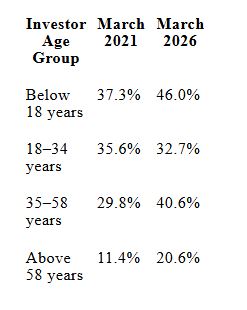
Source: AMFI–Crisil Factbook 2026. Figures represent SIP-linked AUM as a percentage of mutual fund AUM within each age group. They do not represent each age group's share of total industry SIP assets or the percentage of individuals investing through SIPs.
The data shows a notable increase in the proportion of SIP-linked assets among investors above 58 years, rising from 11.4 percent in March 2021 to 20.6 percent in March 2026. This indicates a growing role for systematic investments within the mutual fund portfolios associated with this age group.
Among investors aged 35–58 years, the corresponding proportion increased from 29.8 percent to 40.6 percent. Investments held for minors also recorded an increase, from 37.3 percent to 46 percent.
The 18–34 age category showed a different trend, with the proportion moderating from 35.6 percent to 32.7 percent. Nevertheless, SIP-linked assets continued to account for a substantial share of mutual fund holdings within this category.
Importantly, these percentages measure the composition of mutual fund assets rather than the number of investors participating in SIPs. They should therefore be interpreted as evidence of changing portfolio patterns, not as a direct measure of investor adoption.
The findings suggest that systematic investing has a role across multiple stages of financial life. However, the suitability of an SIP depends on an individual's financial objectives, investment horizon, liquidity requirements and capacity to bear market risk.
Mutual Fund AUM Reaches 21.3 Percent of India's GDP
The expanding scale of India's mutual fund industry is also reflected in its assets-to-GDP ratio.
According to the AMFI–Crisil Factbook 2026, mutual fund AUM represented 15.9 percent of India's gross domestic product in March 2021. By March 2026, the ratio had increased to 21.3 percent, marking a rise of 5.4 percentage points.
This measure indicates the size of mutual fund assets relative to the economy. It does not represent the percentage of India's population investing in mutual funds or the proportion of households holding mutual fund investments.
Although the ratio has increased, India's mutual fund industry remains relatively less developed in terms of assets-to-GDP penetration than several mature financial markets. This points to potential opportunities for wider financial participation as investor awareness, access to financial services and distribution infrastructure continue to develop.
At the same time, growth in industry assets can reflect a combination of fresh investments, market movements and changes in the value of existing holdings. An increase in AUM should not be interpreted solely as an increase in the number of investors.
Bajaj Broking and India's Changing Investment Habits
As mutual funds become part of everyday financial conversations, digital investment platforms are providing investors with additional ways to research, access and monitor investment products.
Bajaj Broking, operated by Bajaj Financial Securities Limited, a wholly owned subsidiary of Bajaj Finance Limited, offers access to more than 4,000 mutual fund schemes through its digital platform.
Investors can explore mutual fund categories, including equity, debt and hybrid schemes, and consider SIP or lump sum investment options based on their financial requirements.
Through its app and web platform, Bajaj Broking provides access to mutual fund investment services and facilities for reviewing investment holdings. Its approach to simplifying the investment process is reflected in its brand positioning, "Seedhi Simple Investing."
For first-time investors, access to information about different schemes may help them understand available investment choices. Existing investors can also use digital platforms to review their portfolios and consider additional investments in line with their financial plans.
However, the availability of a large number of schemes does not necessarily make every scheme suitable for every investor. Mutual funds differ in their investment objectives, asset allocation, volatility, liquidity and risk characteristics.
Investors should review relevant scheme documents, understand associated costs and risks, and assess whether an investment aligns with their individual financial circumstances before making a decision.
The Way India Saves Is Evolving
India's changing financial savings pattern is not necessarily a story of mutual funds replacing fixed deposits or other traditional savings instruments. Rather, it reflects the growing range of investment options available to households and the increasing consideration of market-linked products alongside established savings choices.
Fixed deposits may continue to serve investors seeking predictable returns, subject to applicable terms, while mutual funds provide exposure to different asset classes with varying levels of market risk. The two can serve different purposes within a broader financial plan.
The expansion of digital investment platforms, including Bajaj Broking, has made it more convenient for individuals to explore mutual fund schemes and access investment services.
The broader change may be visible in everyday household conversations. Saving for the future remains a priority, but the choices available to investors have expanded. As financial awareness develops, households are increasingly able to evaluate different ways of allocating their savings according to their goals, time horizons and tolerance for risk.
Standard Disclaimer
Investments in the securities market are subject to market risks. Read all related documents carefully before investing.
Mutual Fund investments are subject to market risks. Read all scheme-related documents carefully before investing.
Systematic investment plans do not assure returns or protect investors against market losses. Past performance is not indicative of future returns.
Bajaj Financial Securities Limited (Bajaj Broking)
Registered Office: 4th Floor, Bajaj Finserv House, Off Pune–Ahmednagar Road, Viman Nagar, Pune – 411014, Maharashtra.
Corporate Office: Bajaj Financial Securities Limited, 1st Floor, Mantri IT Park, Tower B, Unit No. 9 & 10, Viman Nagar, Pune, Maharashtra – 411014.
SEBI Registration No.: INZ000218931
BSE Cash/F&O/CDS Member ID: 6706
NSE Cash/F&O/CDS Member ID: 90177
MCX Member ID: 57680
DP Registration No.: IN-DP-418-2019
CDSL DP No.: 12088600
NSDL DP No.: IN304300
AMFI-Registered Mutual Fund Distributor Registration No.: ARN-163403
APMI APRN: APRN04289
Website: https://www.bajajbroking.in/
(ADVERTORIAL DISCLAIMER: The above press release has been provided by VMPL. ANI will not be responsible in any way for the content of the same.)